
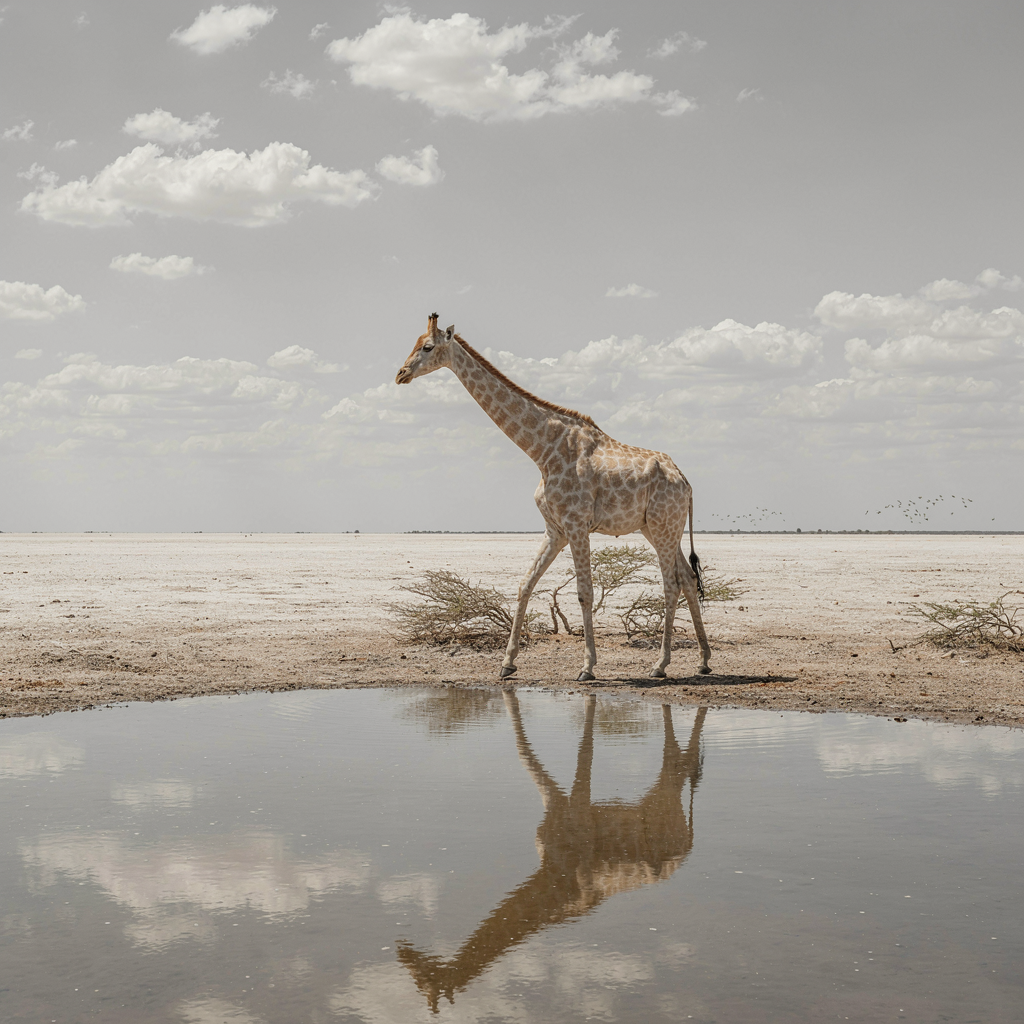
Leucism in wild animals is a pigmentation condition that results in partial or complete loss of coloration in an animal’s fur, feathers, skin, or scales. Unlike albinism, leucistic animals usually retain normal eye pigmentation. It can occur in mammals, birds, reptiles, amphibians, and fish.
Have you ever seen a completely white giraffe, a pale lion, or a hippo that looks almost blonde?
At first, you might think the animal is albino. However, that is not always the case. In many instances, the unusual coloration may be caused by leucism, a fascinating condition that affects pigmentation in animals.
Leucism in wild animals is rare, striking, and scientifically fascinating. It can make an animal appear completely white, unusually pale, or covered with distinctive white patches. Unlike albinism, however, leucism does not necessarily affect pigmentation in the eyes.
So, what exactly causes leucism? How is it different from albinism? And can a leucistic animal survive in the wild?
Let’s explore the remarkable world of leucistic animals and discover why these unusual creatures continue to fascinate wildlife lovers around the world.
What Is Leucism in Wild Animals?
Leucism is a rare condition that results in the loss of some or all of an animal’s normal coloring, making its fur, feathers, skin, or scales unusually pale or white.
It is linked with abnormalities of pigment-producing cells, particularly melanocytes. As a result, an animal may develop white patches, pale coloration, or an almost completely white appearance.
Interestingly, leucism can occur across many groups of animals. Scientists have documented leucistic individuals among mammals, birds, reptiles, amphibians, and fish.
Therefore, seeing a white animal in the wild does not automatically mean you are looking at an albino.
Instead, the animal could be leucistic.
What Causes Leucism in Animals?
The exact biological mechanisms behind leucism can vary between species. Generally, however, leucism involves problems with the development, distribution, or function of pigment-producing cells.
Because pigmentation contributes to an animal’s normal appearance, disruption of these processes can produce dramatic changes in coloration.
Consequently, a normally dark animal might develop:
- Completely white fur
- White feathers
- Pale skin
- White patches
- Reduced coloration
- A mixture of normal and white coloration
In birds, for example, leucism can result in white feathers while the eyes retain their normal coloration.
This is one reason why leucistic wildlife can look so extraordinary.
What’s the Difference Between Leukism and Albinism?
One of the most common questions about strange white animals is if they are albinos.
Whether an animal is leucistic or albino depends on how pigmentation is affected.
| Feature | Leucism | Albinism |
|---|---|---|
| Pigmentation | Reduced or absent in parts or much of the body | Melanin production is severely disrupted |
| Fur/feathers | May be white or partly white | Often very pale or white |
| Eyes | Usually retain normal coloration | Often appear pink, reddish, or unusually pale |
| Pattern | Can occur in patches | Generally affects pigmentation more broadly |
| Wildlife examples | White giraffes, some birds, lions and seals | Albino mammals, birds and reptiles |
The distinction is important because not every white animal is albino. For example, the famous white giraffe Omo in Tanzania was identified as leucistic because she retained pigmentation in her eyes.
Similarly, white lions have been described as leucistic rather than albino because they can retain pigment in areas such as their eyes.
The simplest hint? Take a look at the eyes.
If an unusually white animal has normally colored eyes, leucism may be a possibility.
However, appearance alone cannot always provide a definitive diagnosis. Scientists may need additional evidence to distinguish different pigmentation conditions.
What Do Leucistic Animals Appear Like?
The appearance of leucistic animals can vary considerably.
Some individuals are almost completely white. Others have only a few unusual patches.
For example, a bird may have several white feathers while maintaining its normal body coloration. Meanwhile, a mammal may have a predominantly white coat with small areas of its original coloration remaining.
This means leucism can create some of the most spectacular examples of rare animal coloration in nature.
In birds, leucistic patterns can sometimes appear symmetrical, while other pigmentation abnormalities can produce more irregular patterns.
Therefore, wildlife photographers can encounter animals that look almost like entirely different species simply because of their unusual pigmentation.
Notable Examples of Leucism in Wild Animals
Leucism has been documented in several remarkable wildlife species.
1. White Giraffes
Perhaps some of the most famous examples are white giraffes.
In Tanzania’s Tarangire National Park, a famous white giraffe named Omo attracted international attention because of her extraordinary appearance. She was identified as leucistic rather than albino because her eyes retained pigmentation.
White giraffes have also been documented in Kenya.
However, their unusual appearance can make them particularly vulnerable to human attention. Conservationists have therefore emphasized the importance of protecting rare animals from poaching and excessive disturbance.
2. White Lions
White lions are another striking example.
Although they are sometimes described as albino, white lions are generally considered leucistic because they retain pigmentation in certain tissues, including their eyes.
Their pale coats can make them visually spectacular. At the same time, however, unusual coloration could potentially affect camouflage in certain environments.
3. Leucistic Penguins
Penguins can also develop unusual pigmentation.
A famous leucistic Adélie penguin photographed in Antarctica appeared dramatically paler than the other penguins around it. Experts identified the bird’s coloration as a genetic pigmentation variation.
Leucistic and unusually pale penguins demonstrate just how diverse pigmentation abnormalities can be in wildlife.
4. Leucistic Seals
Rare pale fur seals have also been documented.
National Geographic reported leucistic fur seals on South Georgia Island, where researchers noted that these unusual color mutations did not necessarily appear to affect the animals’ normal behavior.
This highlights an important point: looking different does not automatically mean an animal is unhealthy.
Can leucistic animals survive in the wild?
Yes, leucistic animals can survive in the wild.
But they need a few things to survive.
First, color can impact camouflage. If a lot of the animal turns white, it is more likely to stand out. Usually, the animal blends in with the surroundings.
This could make hunting easier for predators.
Conversely, prey species might become more visible to predators.
But the effect is not universal.
Some leucistic animals live for many years and reproduce normally. Leucistic animals have been observed in research and in the wild, and they appear to function normally and be accepted in their social groups.
Thus, it is a fallacy to believe that all leucistic animals have a poor chance of survival.
Does Leucism Make Animals Rare?
Leucism is considered uncommon in natural populations, although its frequency varies between species and locations.
When a leucistic animal appears in the wild, it can quickly attract attention because it looks dramatically different from its companions.
For wildlife enthusiasts, the sight creates a fascinating opportunity to observe natural variation.
However, there is an important conservation lesson here.
Rare does not mean entertainment.
When an unusually colored animal is discovered, sharing its exact location publicly can sometimes increase risks from poaching, harassment, or excessive human visitation.
The story of rare white giraffes demonstrates why responsible wildlife tourism and photography matter.
Is Leucism Genetic?
Genetics can play an important role in unusual animal coloration.
Some forms of leucism are associated with genetic changes affecting pigmentation and pigment-cell development. Scientific literature has identified genetic mechanisms that can contribute to abnormal coloration.
Nevertheless, pigmentation abnormalities are complex.
Not every white patch observed in an animal should automatically be classified as leucism. Other conditions, injuries, age-related changes, and processes such as progressive greying can also cause white feathers or hair.
Consequently, identifying a pigmentation condition requires careful observation and, in some cases, expert examination.
Are Leucistic Animals Albino?
No. Leucistic animals are not necessarily albino.
This is one of the most important facts to remember.
Albinism primarily involves a disruption of melanin production. Leucism, on the other hand, generally involves abnormalities affecting pigment cells and can result in reduced pigmentation across the skin, fur, feathers, or scales while leaving eye pigmentation intact.
So, when you see a white animal in the wild, don’t immediately call it an albino.
It could be leucistic, isabelline, progressively grey, or affected by another pigmentation variation.
Why Do Leucistic Animals Matter in the Study of Wildlife?
Beyond their beauty, leucistic animals provide scientists with opportunities to understand animal genetics, pigmentation, evolution, and adaptation.
Animal coloration can influence:
- Camouflage
- Predator avoidance
- Mate selection
- Social recognition
- Thermoregulation
- Survival
- Population genetics
Therefore, unusual coloration is more than just a visual curiosity.
It can offer scientists valuable clues about how animals develop and adapt to their environments.
Leucism Makes Wildlife Even More Fascinating.
Nature rarely follows a single pattern.
From golden monkeys and spotted leopards to white giraffes and pale penguins, wildlife constantly reminds us that biological diversity can be astonishing.
Leucism in wild animals is one of those remarkable examples.
It shows how changes in pigmentation can transform an animal’s appearance while allowing it to remain recognizably the same species.
Most importantly, these animals remind us that wildlife conservation is about protecting individual variation as well as entire species.
The next time you encounter a strikingly white animal on safari, therefore, take a closer look.
Those dark eyes might reveal that you are not looking at an albino at all.
You may be looking at one of nature’s rarest spectacles: a leucistic animal.
Frequently Asked Questions About Leucism in Wild Animals
What is leucism in wild animals?
Leucism is a pigmentation condition in which an animal develops reduced or absent coloration in its fur, feathers, skin, or scales. Unlike albinism, eye pigmentation is generally retained.
How can you tell if an animal is leucistic?
A white or unusually pale body combined with normally colored eyes can suggest leucism. However, visual appearance alone cannot always provide a definitive diagnosis.
Is leucism the same as albinism?
No. Albinism primarily involves disrupted melanin production, while leucism involves abnormalities associated with pigment cells and pigmentation distribution.
Can leucistic animals survive in the wild?
Yes. Some leucistic animals survive, reproduce, and behave normally. However, unusual coloration can sometimes affect camouflage and visibility to predators or prey.
Which animals can have leucism?
Leucism can occur in many vertebrates, including mammals, birds, reptiles, amphibians, and fish.
Are white giraffes albino?
Not necessarily. Famous white giraffes such as Omo in Tanzania have been identified as leucistic because they retain pigmentation in their eyes.
Contact our expert at info@entaleafricansafaris.com or +256777830855 for any inquiries or explanations about this trait in the wild.