
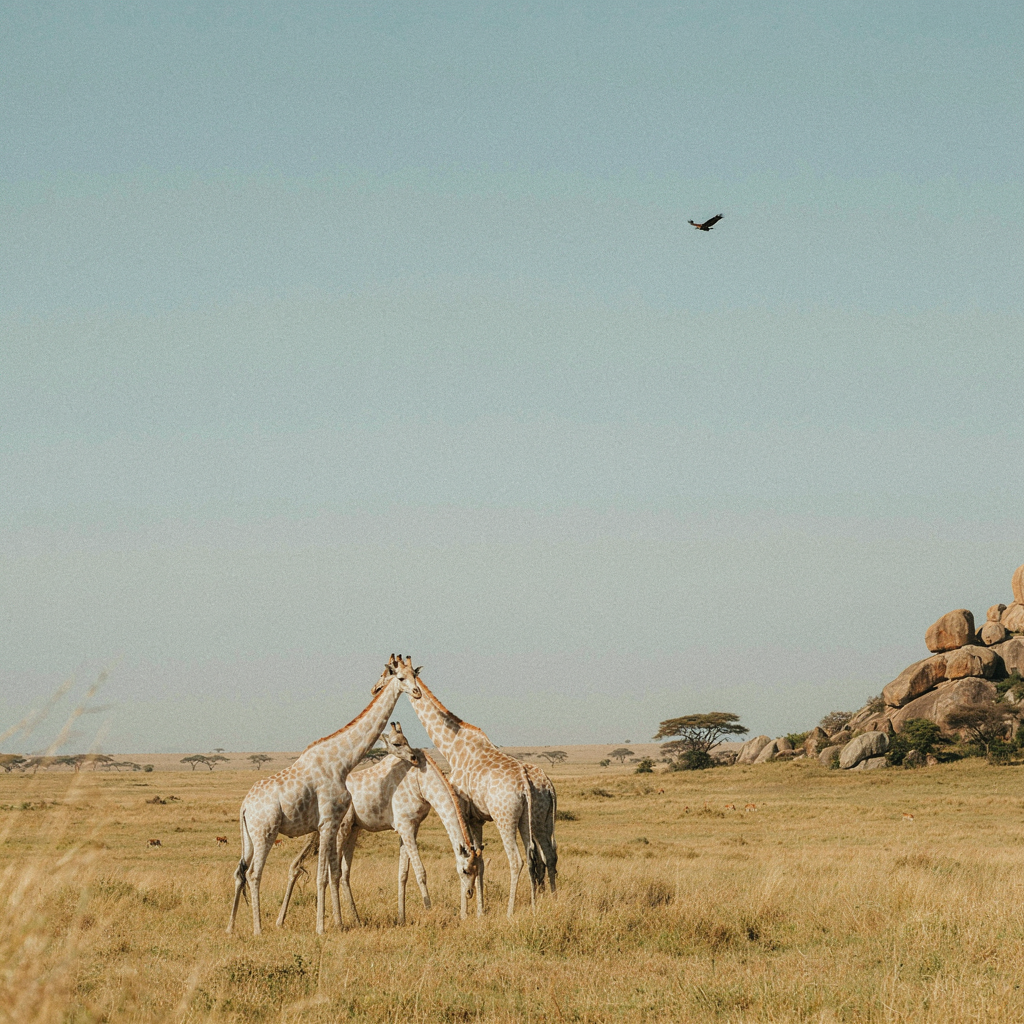
For those interested in African wildlife, Omo the white giraffe is more than just a beautiful sight. The strange color is a result of leucism, a rare pigmentation condition that can cause animals to appear pale or white. Her story is a reminder that every safari can hold something new, something unexpected and unforgettable.
And the wonder doesn’t end in Tanzania. Wildlife enthusiasts in Uganda might also hear of the leucistic hippo in Katunguru, near the famous Kazinga Channel in Queen Elizabeth National Park. Omo, the white giraffe, and this rare pale hippo inspire us to travel to Africa and experience those rare and extraordinary moments in nature on our own journeys.
But what makes these animals so special? Are they albinos? How does leucism occur? And, most importantly, can you see such rare wildlife while on safari?
Let’s explore.
What Is Leucism in Wild Animals?
Leucism is a rare pigmentation condition that causes an animal to lose some or much of its normal coloration.
As a result, an animal may appear white, cream-colored, unusually pale, or covered with distinctive white patches. Unlike albinism, leucism does not necessarily remove pigmentation from the eyes.
This distinction is particularly important when discussing white giraffes and leucistic hippos.
In other words, seeing a white animal in the African wilderness does not automatically mean you have discovered an albino animal.
Instead, you may be witnessing one of nature’s fascinating genetic variations.
Omo: The Famous White Giraffe of Tanzania
Few wildlife stories capture the imagination quite like that of Omo, the white giraffe of Tanzania.
Omo was first documented in Tarangire National Park, where researchers from the Wild Nature Institute encountered the unusual giraffe among normally patterned Masai giraffes. She was named Omo by a local guide after a popular detergent brand.
What made Omo extraordinary was not simply that she looked white.
She was leucistic.
Her skin lacked much of the pigmentation normally responsible for the characteristic giraffe pattern, while her eyes retained their normal dark coloration. This helped distinguish her from a truly albino animal.
And that is exactly what makes her story so fascinating.
Imagine watching a herd of beautifully patterned giraffes moving slowly across the Tanzanian landscape, only to notice one pale figure towering above the surrounding vegetation.
That is the kind of wildlife encounter you remember for life.
Why Omo Was So Remarkable
Omo’s unusual appearance was not merely beautiful; it potentially presented survival challenges.
Young giraffes face serious threats from predators, including lions, hyenas, and wild dogs. Because Omo’s pale coloration made her more visually conspicuous, researchers were particularly interested in whether she could survive in the wild.
Fortunately, researchers repeatedly documented her alive and apparently doing well.
The Wild Nature Institute reported seeing Omo again approximately one year after her original sighting and later documented her when she was more than two years old. She was observed with her normal-colored herd, apparently accepted by the group.
That survival story makes Omo more than a beautiful animal.
She became a symbol of the resilience and unpredictability of African wildlife.
Is Omo an albino giraffe?
No. Omo is known as a leucistic giraffe, not an albino giraffe.
This is an important difference.
With leucism, pigmentation can be reduced or absent in parts of the body while the eyes retain pigmentation. With albinism, melanin production is severely disrupted throughout the body, and the eyes can appear very pale or reddish because of reduced pigmentation.
Omo retained dark eyes and some coloration, including her distinctive mane and tail features.
Therefore, when searching for white giraffes in Tanzania, you may encounter the term “leucistic giraffe” far more accurately than “albino giraffe.”
The Leucistic Hippo of Kazinga Channel, Uganda
Now let’s travel from Tanzania to Uganda.
In southwestern Uganda lies Queen Elizabeth National Park, one of the country’s most remarkable wildlife destinations. The park is home to elephants, lions, buffaloes, leopards, antelopes, birds, and one of its most famous aquatic residents, the hippopotamus.
At the heart of the park is the spectacular Kazinga Channel, a natural waterway connecting Lake Edward and Lake George.
The channel is particularly renowned for its extraordinary concentration of hippos. Visitors on boat cruises can often watch these enormous animals resting in the water, yawning, interacting with one another, and occasionally emerging onto the banks.
Among such a large population, however, an unusually pale or leucistic hippo would be an extraordinary sight.
Nevertheless, the possibility of encountering an unusually pale hippo adds another fascinating dimension to wildlife photography along the channel.
Why the Kazinga Channel Is Perfect for Wildlife Lovers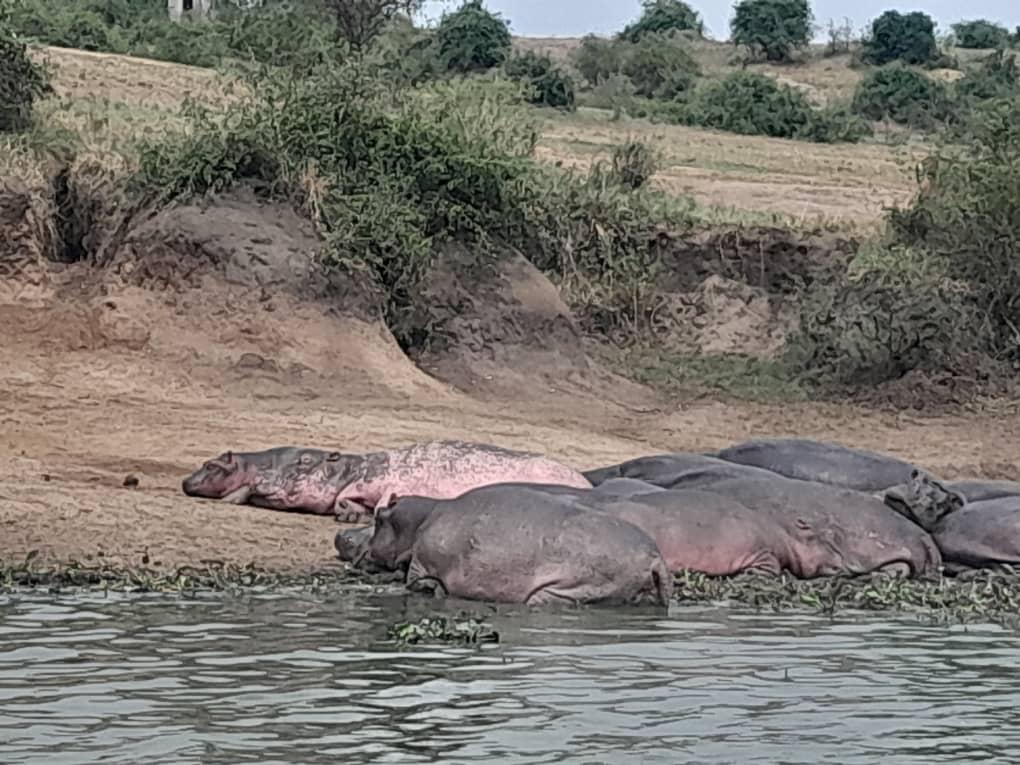
Even without searching specifically for a rare-colored hippo, a Kazinga Channel boat safari can be an unforgettable experience.
As your boat moves slowly along the water, you may encounter enormous hippos partially submerged in the channel.
Then, suddenly, one may lift its head.
Its ears twitch.
Its nostrils emerge above the surface.
And moments later, it may open its enormous mouth in a spectacular yawn.
The channel also attracts elephants and numerous water-associated birds, creating an extraordinary wildlife-viewing environment.
For photographers, the experience becomes even more exciting because the water provides a natural setting for dramatic wildlife photographs.
So, while you may set out hoping to spot unusual coloration, you could return with memories of hippos, elephants, buffaloes, birds, crocodiles, and other wildlife.
That unpredictability is part of what makes an African safari so special. Contact us today for a thrilling East African adventure at info@entaleafricansafaris.com.
Why Rare Wildlife Encounters Make African Safaris Special
A safari is not a zoo visit.
There are no guarantees.
You cannot simply walk into an enclosure and ask a rare animal to come closer.
Instead, you travel through vast ecosystems, follow animal tracks, scan the horizon, listen to your guide, and wait.
Occasionally you encounter a lion resting beneath a tree.
Sometimes elephants cross the road.
Occasionally a leopard appears for only a few seconds.
And, on exceptionally fortunate occasions, you encounter an animal whose appearance is extraordinarily unusual.
That sense of discovery is what makes African wildlife safaris so addictive.
You are not merely looking at animals but simply entering their world.
Could You See a White Giraffe on Safari in Tanzania?
This area is where expectations are important.
Omo became famous after researchers documented her in Tarangire and reported seeing her multiple times. However, wildlife is constantly on the move, and you can never guarantee seeing a particular individual animal.
While you may hope to see Omo, you should not book a safari solely for that reason.
Instead, visit Tarangire National Park for its extraordinary ecosystem and diverse wildlife, while understanding that rare individual sightings are a matter of chance.
That actually makes the experience more exciting.
You could spend hours watching giraffes moving through the woodland and never see the rare individual you hoped for.
Or suddenly…
There she is.
A pale silhouette rising above the trees.
And for a few magical moments, you are looking at one of the most unusual giraffes ever documented.
Could You See a Rare Hippo on the Kazinga Channel?
The same principle applies in Uganda.
The Kazinga Channel is renowned for its hippo population, so a boat cruise offers excellent opportunities to observe hippos in their natural environment.
However, individual animals move between areas, and safari operators should never guarantee unusual coloration.
Instead, the real attraction is the experience itself.
Imagine sitting quietly on a boat while dozens of hippos surround you.
Water ripples across the channel.
African fish eagles call from nearby trees.
Elephants approach the shoreline.
Then your guide points toward something unusual.
“Look over there.”
That moment is precisely why people travel thousands of miles for an African safari.
Best Safari Experiences for Wildlife Photography
If you love wildlife photography, these destinations offer entirely different experiences.
Tanzania: Tarangire National Park
Tarangire is an excellent destination for experiencing giraffes, elephants, lions, birds, and other wildlife against a beautiful northern Tanzanian landscape.
The possibility of unusual giraffe sightings adds another layer of excitement.
Uganda: Kazinga Channel
A boat cruise on the Kazinga Channel provides an entirely different perspective.
Instead of following animals from a safari vehicle, you watch wildlife from the water.
Hippos dominate the experience, while elephants, buffaloes, and birds can add unforgettable photographic moments.
Responsible Wildlife Tourism Matters
Rare animals attract attention.
Unfortunately, this attention can sometimes lead to dangerous situations.
A rare animal can attract photographers, tourists, poachers, or people looking for social-media content.
Therefore, responsible safari tourism is essential.
When searching for rare wildlife:
- Keep a respectful distance.
- Follow your guide’s instructions.
- Never chase an animal for a photograph.
- Avoid disturbing wildlife.
- Do not attempt to feed wild animals.
- Avoid sharing sensitive locations of vulnerable wildlife.
- Choose responsible safari operators like us
- Support conservation initiatives.
Ultimately, the goal should not simply be getting the perfect photograph.
It should be ensuring that the animal can continue living safely in its natural habitat.
Your Ultimate East African Adventure Starts Now;
If you have always dreamed of an African safari, these two destinations deserve serious consideration.
Tanzania offers spectacular wildlife landscapes, iconic national parks, the Great Migration, extraordinary giraffe sightings, elephants, lions, leopards, and countless other species.
Uganda, meanwhile, offers a more intimate wildlife experience, from gorilla trekking and chimpanzee tracking to savannah game drives and boat safaris along the Kazinga Channel.
And that is the beauty of combining East African destinations.
One journey can take you from the open landscapes of Tanzania to the lush ecosystems of Uganda.
You can watch giraffes against the Tanzanian horizon.
Then, days later, you can sit quietly on a Ugandan boat surrounded by hippos.
You never know what nature will reveal next. Talk to our safari expert at info@entaleafricansafaris.com or +256777830855
Your Next African Wildlife Adventure Awaits
Omo, the white giraffe, is a reminder that nature does not always follow the rules we expect.
The extraordinary story of this leucistic giraffe in Tanzania shows how a genetic variation can create an animal that looks almost entirely different from its relatives.
Meanwhile, the fascinating possibility of encountering unusual wildlife along Uganda’s Kazinga Channel demonstrates why every safari should leave room for surprise.
You may travel to Africa hoping to see the Big Five.
You may dream about gorillas.
You may want photographs of elephants and lions.
But occasionally, the memory that stays with you forever is something completely unexpected.
A pale giraffe appearing among a herd.
A rare-looking hippo emerging from the water.
A moment that no itinerary can guarantee.
That is the magic of an African safari.
And if you’re ready to experience it for yourself, Uganda and Tanzania are waiting.
Frequently Asked Questions
What is Omo the white giraffe?
Omo is a famous leucistic Masai giraffe documented in Tanzania’s Tarangire National Park. Her unusual pale appearance results from leucism rather than albinism.
Is Omo the giraffe albino?
No. Omo is described as leucistic. She retained pigmentation in her eyes and some other tissues, distinguishing her from a typical albino animal.
Where was Omo the white giraffe found?
Omo was documented in Tarangire National Park in Tanzania, where wildlife researchers observed her with normally colored giraffes.
What is the Kazinga Channel famous for?
The Kazinga Channel in Uganda is renowned for its high concentration of hippos and excellent boat-based wildlife viewing. The channel connects Lake George and Lake Edward within Queen Elizabeth National Park.
Can tourists see a leucistic hippo at Kazinga Channel?
A reported unusually pale hippo should be treated cautiously unless its identity and leucistic condition have been scientifically confirmed. However, the Kazinga Channel is an excellent place to see large numbers of hippos and other wildlife.
Where can I see unusual wildlife in Africa?
Uganda and Tanzania are excellent destinations for wildlife enthusiasts. Tarangire offers exceptional giraffe and elephant viewing, while Uganda’s Queen Elizabeth National Park provides outstanding boat-based wildlife viewing along the Kazinga Channel. For an inquiry, send us an email at info@entaleafricansafaris.com, and we shall break down for you all what you need to plan for a thrilling safari in East Africa.