
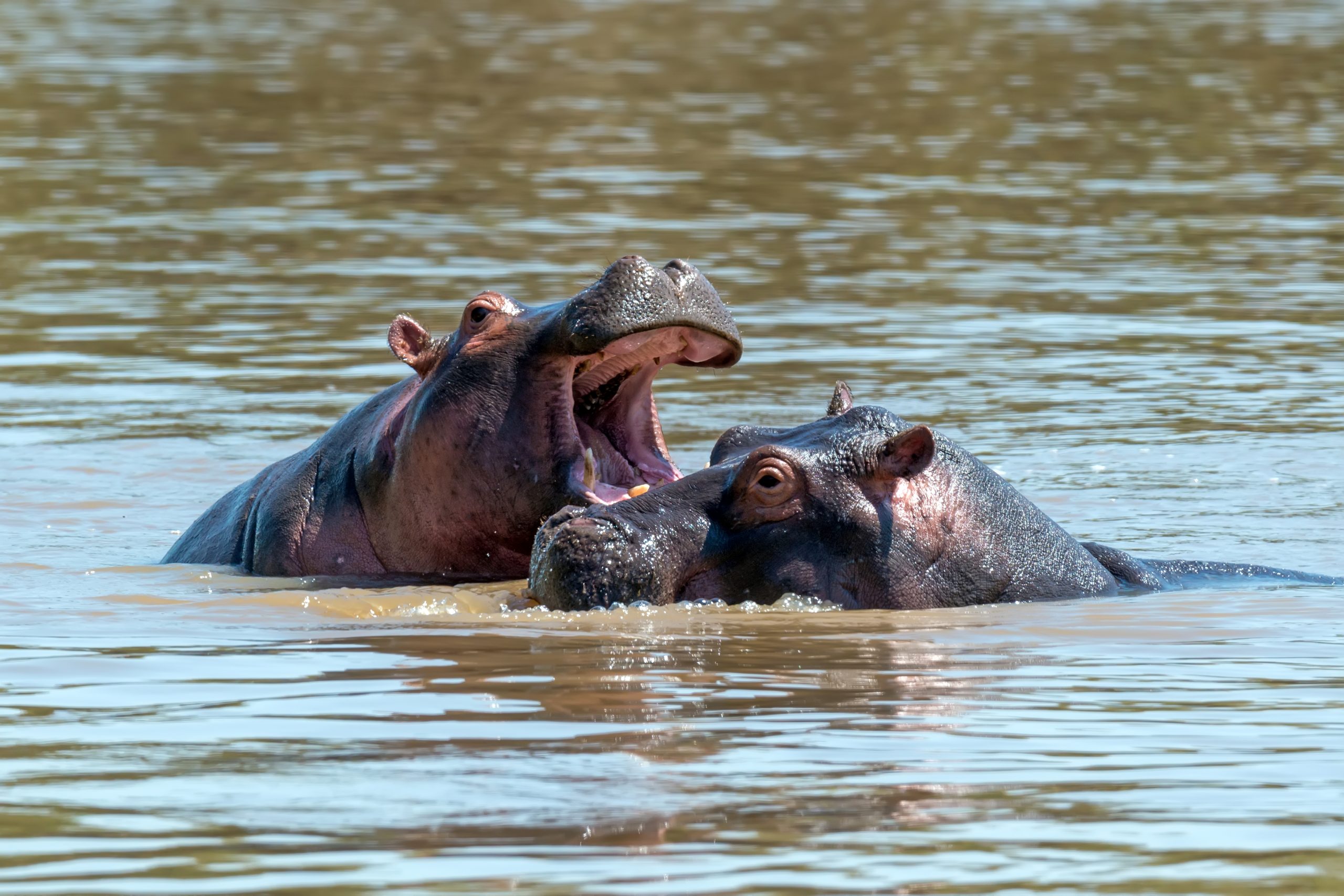
Imagine sitting quietly beside an African river as a giant hippo slowly rises from the water. Its ears twitch, its nostrils open, and suddenly its enormous mouth stretches wide. Is it yawning, warning another hippo, or simply showing off? Hippo behavior is far more fascinating than it first appears.
For travelers exploring Africa, watching hippos is not only about seeing a large animal resting in the water. Their movements, sounds, social interactions, and nighttime habits reveal a complex animal adapted perfectly to life around rivers, lakes, and wetlands. From territorial displays to playful interactions between mothers and calves, every moment reveals something about their lives.
Understanding hippo behavior can also make your safari more meaningful. Whether you are cruising along Uganda’s Kazinga Channel or watching hippos gather beside Tanzania’s Rufiji River, knowing what you are seeing helps you appreciate these remarkable animals while respecting their space.
What Does Hippo Behavior Tell Us?
Hippos may look relaxed as they float in the water, but there is always something happening beneath the surface.
During the hottest parts of the day, hippos spend much of their time in water or mud. This helps them regulate their body temperature and protect their sensitive skin from prolonged exposure to the sun. As evening approaches, they leave the water and begin grazing, often following familiar paths to grassy feeding areas.
This day-and-night routine explains why a hippo can appear almost motionless during a daytime boat safari but become much more active after sunset.
Why Do Hippos Open Their Mouths?
One of the most dramatic examples of hippo behavior is the famous wide-open-mouth display.
It can look like a giant yawn. However, when directed toward another hippo, especially around territorial disputes, it can be a warning or threat display. The animal exposes its enormous teeth and communicates that it is prepared to defend its space.
So, when you see a hippo opening its mouth during a safari, don’t simply think, “That hippo is tired.”
You may be watching a powerful conversation.
Why Do Hippos Spray Their Dung?
This act is one of the strangest but most fascinating behaviors to witness.
Hippos sometimes wag their tails rapidly while defecating, spreading dung across the surrounding area. This behavior is associated with communication and signaling, although its exact function can vary and is not thoroughly understood.
It may look funny from a distance, but it plays a role in the complex social world of hippos.
Why Do Hippos Make So Many Sounds?
Hippos are surprisingly vocal animals.
They can produce grunts, wheezes, honks, roars, and other sounds. These vocalizations can be important during social interactions, territorial encounters, and moments of excitement. Some hippo sounds can travel through both air and water, making their communication especially unusual among mammals.
A quiet-looking hippo pod may therefore be much more socially active than it appears.
Hippo Social Behavior: Life in the Pod
Hippos are highly social while resting in water. Groups can contain many individuals, including females, young animals, subordinate males, and a dominant territorial male.
However, their social lives change when they leave the water.
At night, hippos generally spread out to graze. Mothers may remain close to their young, while other individuals move independently across grasslands. This difference between daytime gatherings and nighttime feeding makes hippo behavior especially fascinating to observe.
Mother and Calf Behavior
Among the most heartwarming sights on safari is a hippo mother staying close to her calf.
Young hippos depend heavily on their mothers for protection. Within crowded pods, adults constantly interact, move, and respond to one another. Mothers can become particularly defensive when they believe their young are threatened.
For visitors, this incident is an important reminder: wildlife viewing should always give hippos plenty of space.
Why Hippos Can Be Dangerous
Despite their heavy bodies and seemingly slow movements, hippos should never be underestimated.
They are powerful wild animals with strong territorial instincts. A hippo may react aggressively when it feels threatened, especially when another animal or person blocks its route between water and land.
This is particularly important because hippos often use established paths between their daytime resting areas and nighttime feeding grounds.
During a safari, always follow your guide’s instructions. Never approach a hippo on foot, block its path, or attempt to get closer for a photograph.
The best wildlife encounter is one where both you and the animal remain comfortable and safe.
Hippo Conservation: Why These Giants Need Protection
The common hippopotamus is currently classified as Vulnerable on the IUCN Red List. Although hippos remain widespread across parts of Africa, populations face serious pressures in several regions.
The major conservation challenges include:
- Habitat loss and degradation
- Water pollution
- Changes to natural water systems
- Illegal and unregulated hunting
- Human-wildlife conflict
- Loss of access to suitable grazing and freshwater habitats
Because hippos depend heavily on freshwater ecosystems, protecting rivers, lakes, wetlands, and surrounding grasslands is essential.
Hippo Conservation in Uganda
Uganda remains an important stronghold for hippos in East Africa.
According to Uganda’s 2026 State of Wildlife Resources report, hippos are widespread in Uganda but are especially concentrated in Queen Elizabeth National Park and Murchison Falls National Park. The report recorded an estimated 9,026 hippos in 2023–2025, representing an increase from the previous estimate of 8,226. More than 77% of the recorded population occurred in the Queen Elizabeth Conservation Area.
This is encouraging news. However, continued protection of freshwater habitats and responsible wildlife management remain essential.
Where to See Hippos in Uganda
1. Queen Elizabeth National Park
If you want an unforgettable hippo safari in Uganda, Queen Elizabeth National Park should be high on your list.
The park’s famous Kazinga Channel connects Lake George and Lake Edward and provides one of Africa’s most spectacular places to observe hippos.
A boat cruise allows you to watch hippos resting in the shallows while crocodiles bask nearby and elephants, buffaloes, waterbirds, and other wildlife gather along the banks. Uganda Wildlife Authority describes the Kazinga Channel as having one of the highest concentrations of hippos in Uganda.


This is one of those safari moments where you don’t need to chase wildlife. Simply slow down, watch the water, and let the animals reveal themselves.
2. Murchison Falls National Park
Murchison Falls National Park is another excellent destination for seeing hippos in Uganda.
The Nile provides important aquatic habitat, while the park’s riverbanks support a remarkable variety of wildlife. Hippos can be observed during boat activities and game-viewing experiences around the river.
For travelers combining wildlife, landscapes, and river adventures, Murchison Falls offers a very different hippo experience from the Kazinga Channel.
3. Lake Mburo National Park
Lake Mburo National Park also supports hippos and offers a more intimate wildlife experience.
The park’s lakes and wetlands create suitable habitat for aquatic wildlife. Because Lake Mburo is relatively compact compared with Uganda’s larger parks, it can work particularly well for travelers looking for a shorter safari experience.
Where to See Hippos in Tanzania
Tanzania offers some extraordinary opportunities to observe hippos in their natural habitats.
1. Serengeti National Park
The Serengeti is famous for lions, leopards, cheetahs, and the Great Wildebeest Migration. Yet its hippos deserve attention too.
One of the most famous places to see them is the Retima Hippo Pool in the central Serengeti, where permanent water attracts large numbers of hippos. The pool is particularly dramatic when animals gather closely together during drier periods.


Here, you can watch hippos jostling for space, vocalizing, opening their enormous mouths, and occasionally displaying territorial behavior.
It is a fascinating opportunity to observe hippo behavior up close while remaining at a safe distance.
2. Nyerere National Park
For an entirely different experience, head south to Nyerere National Park.
The Rufiji River and its interconnected channels, floodplains, and oxbow lakes support abundant hippos and crocodiles. Boat safaris provide an excellent way to experience this aquatic ecosystem.


Imagine drifting quietly along the river while hippos surface nearby and elephants come to drink along the banks.
It is not simply wildlife viewing.
It is Africa unfolding around you.
3. Ngorongoro Crater
The Ngorongoro Crater is another excellent place to include hippos on a Tanzania safari.
The crater floor contains permanent water sources and wetlands that support a rich concentration of wildlife. Hippos can be seen around places such as Ngoitokitok Springs, adding another fascinating dimension to a crater game drive.

4. Ruaha National Park
For travelers who prefer quieter and less crowded safari experiences, Ruaha National Park is worth considering.
The Great Ruaha River is a major attraction, and the park supports hippos alongside elephants, crocodiles, buffaloes, lions, leopards, and many other species.
Ruaha gives travelers the opportunity to experience hippos within a vast and rugged southern Tanzanian wilderness.
The Best Time to See Hippos in Uganda and Tanzania
In both Uganda and Tanzania, you can see hippos throughout the year.
However, the dry season can offer particularly rewarding sightings because animals often concentrate around permanent water sources as smaller water bodies disappear.
This can make places such as the Kazinga Channel, Retima Hippo Pool, and Rufiji River especially impressive.
Still, every season has something different to offer. During wetter months, landscapes become greener, temporary water sources expand, and wildlife may spread across a larger area.
So, rather than waiting for a “perfect” season, choose your travel period based on the overall safari experience you want.
Why Hippo Behavior Makes a Safari More Exciting
A safari becomes much more meaningful when you understand what you are seeing.
When a hippo yawns, you can recognize a possible warning display. When one sprays dung, you understand that communication may be taking place. When the entire pod becomes noisy, you can begin to appreciate the social interactions happening around you.
Most importantly, understanding hippo behavior teaches us to respect wildlife.
These animals are not performers waiting for visitors. They are wild creatures following ancient routines that depend on healthy rivers, lakes, wetlands, and grasslands.
Hippo Conservation and Responsible Safari Tourism
Responsible tourism can contribute to wildlife conservation when tourism revenue supports protected areas, conservation programs, guides, local communities, and habitat protection.
As travelers, we can also make a difference by choosing responsible safari operators, following wildlife-viewing guidelines, avoiding litter, respecting local communities, and never encouraging guides to approach animals too closely.
Every respectful encounter helps create a tourism culture where wildlife is valued for what it is: wild.
Protecting hippos therefore means protecting more than one species. It means protecting the freshwater ecosystems and landscapes that support countless other animals, birds, plants, and communities.
Conclusion
Hippo behavior reveals a fascinating world of communication, social relationships, territorial displays, nighttime grazing, and survival. From the famous open-mouth warning to the mysterious sounds echoing across the water, every behavior gives us another reason to appreciate these powerful African giants. Their conservation is equally important, because protecting hippos means protecting the rivers, lakes, wetlands, and grasslands they depend on.
Whether you choose Uganda’s Kazinga Channel, Murchison Falls, or Lake Mburo, or explore Tanzania’s Serengeti, Nyerere, Ngorongoro, or Ruaha, a hippo encounter can become one of the most memorable moments of your African safari. With the right guide and a respectful approach, you can do more than simply see hippos—you can understand them, appreciate their world, and leave with a deeper connection to Africa’s wild heart.
Why Book Your Hippo Safari with Entale African Safaris?
At Entale African Safaris, we believe your safari should be more than a checklist of animals.
We want you to experience the stories behind the wildlife.
We can help create an experience around your interests, whether it’s watching hippos along the Kazinga Channel, exploring Uganda’s savannas, tracking gorillas in Bwindi, or combining Uganda with a Tanzania safari. Contact us at info@entaleafricansafaris.com or +256777830855
You bring the dream. We help turn it into an African adventure.